A Baltimore arcade operator thought someone had passed him a counterfeit ten-dollar bill. He followed the customer to a tavern and told a police officer. The bill was worn and musty, but the Secret Service determined the money was real. The FBI checked the serial numbers. The bill had attracted attention for looking wrong; the numbers pointed to money stolen from Brink’s in Boston more than six years earlier. [1]
That was June 1956. By then Joseph “Specs” O’Keefe had told investigators how the gang pulled off the robbery. He couldn’t tell them where the other men had put their shares. Catching the men and finding the money had become two different jobs. [1]
Five employees and a buzzer
On January 17, 1950, five employees were securing the day’s collections at the Brink’s building on Prince Street. Masked men held them at gunpoint, bound them and covered their mouths. A buzzer sounded during the robbery. The men kept going. They left with more than $1.2 million in cash and another $1.5 million in checks and other securities. [1]
Investigators collected rope and tape and a chauffeur-style cap left behind. They recorded details of the weapons taken from Brink’s. One of those guns later turned up near the Mystic River. Pieces of a disassembled truck in Stoughton drew attention because the vehicle resembled one seen near Brink’s and had been reported stolen. The cap survives as an FBI artifact. It didn’t give the five employees a face they could identify. [1] [2]
The first grand jury went home without indictments
Investigators suspected O’Keefe, Anthony Pino and other men they’d been checking on. A federal grand jury began hearing evidence in late 1952. The employees hadn’t been able to identify the masked men, and investigators hadn’t secured testimony to fill the gap. The grand jury returned no indictments in January 1953. [1]
O’Keefe and Stanley Gusciora had been arrested in Pennsylvania in 1950 on unrelated matters. O’Keefe needed money for legal expenses and grew angry with the people he thought should help him. He survived attempts on his life in 1954. On January 6, 1956, he began telling FBI agents who’d taken part, how they’d learned the building and how they’d carried out the robbery. The agents had years of work against which to check what he said. [1]
A Suffolk County grand jury indicted the gang that month. O’Keefe pleaded guilty on January 18. Gusciora died before trial. The jury convicted the eight defendants who went to trial that autumn, and the court imposed life terms and additional sentences on other counts. Their state appeals failed in 1959, and the U.S. Supreme Court declined further review. [1]
Behind a wall on Tremont Street
Of the $4,822 police found in the Baltimore visitor’s possession, the FBI identified $4,635 as Brink’s money. The man first said he’d come across it while working on a foundation. He later described a Boston office on Tremont Street where someone had pulled packages of bills from behind a wall panel. [1]
Agents searched the office on June 4. They found a picnic cooler behind a partition. It held more than $57,700, of which $51,906 could be identified as part of the robbery haul. Some of the damp bills fell apart when handled. The FBI’s account puts the currency still unaccounted for after those recoveries at more than $1.15 million. The men had spent years trying to keep their part in the robbery quiet. The arcade operator needed only one bill to ask where the money had been. [1]
Case brief
Boston, Massachusetts · 1950
- Recorded outcome
- O'Keefe pleaded guilty in 1956; eight defendants convicted and sentenced that year; appeals unsuccessful in 1959.
Key moments
People and case photographs
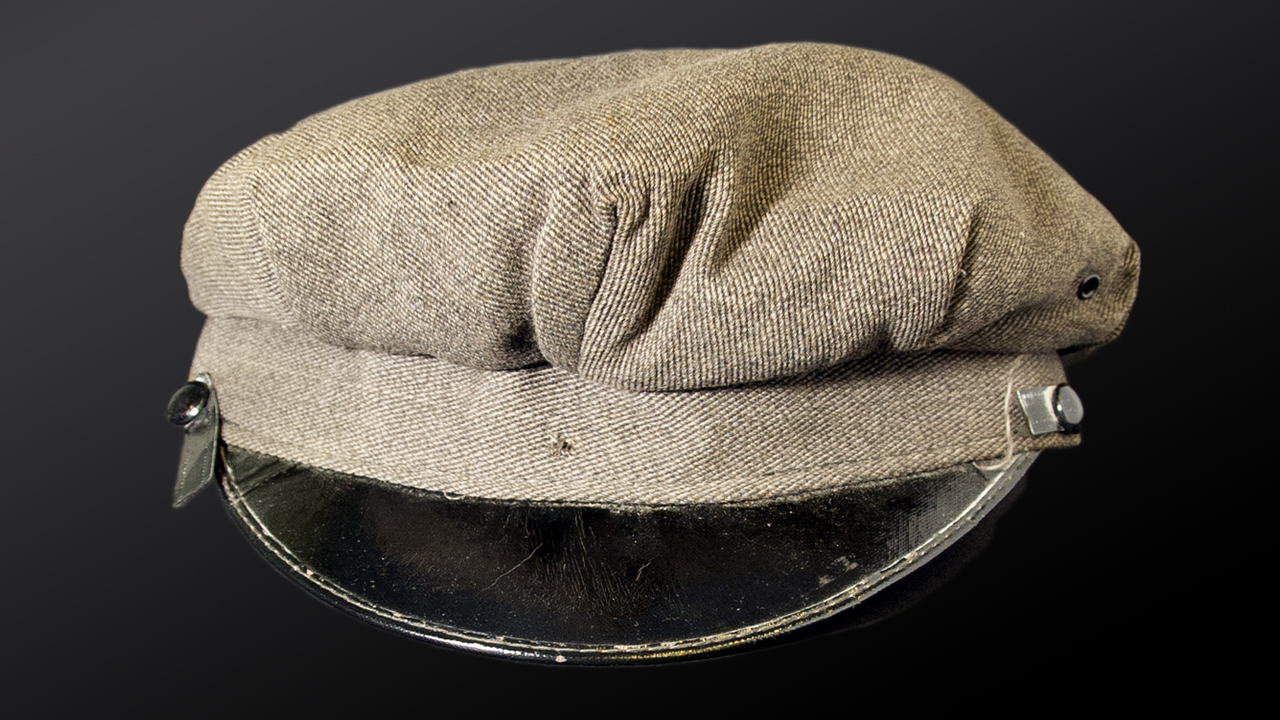
The cap left at Brink’s The FBI photographed the chauffeur’s cap left at the scene of the 1950 robbery. Investigators examined it but did not identify the robbers from the cap.
Photograph of recovered evidence · Federal Bureau of Investigation · Public Domain Mark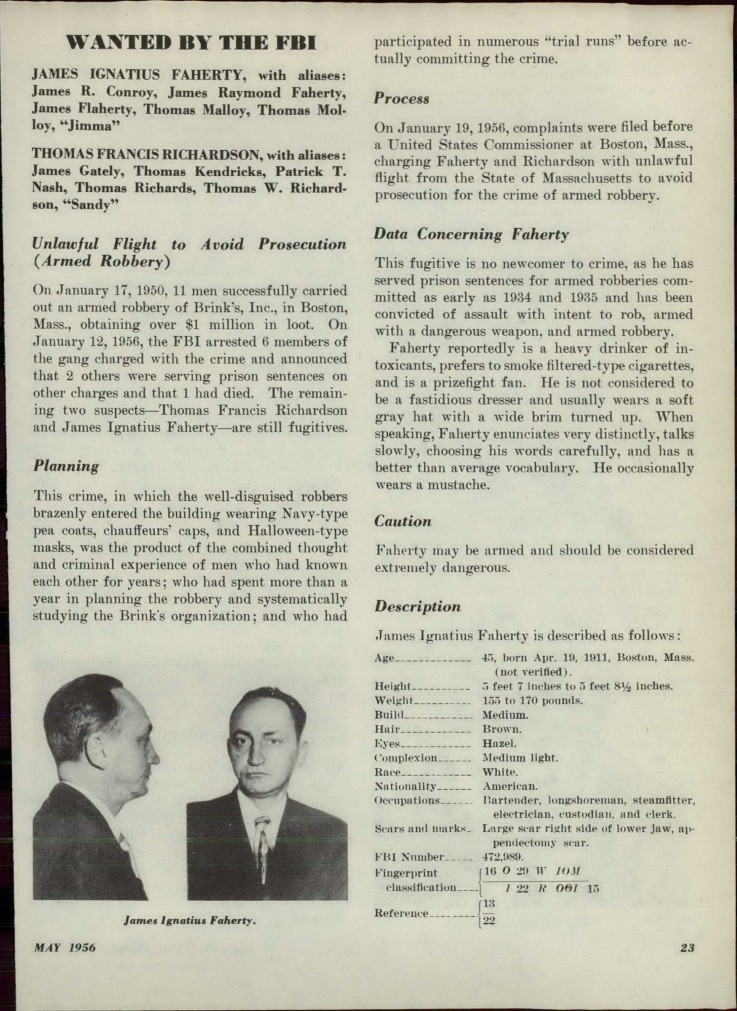
James Ignatius Faherty The FBI published this notice while Faherty was a fugitive. He was later convicted in the 1950 Brink’s robbery.
Archival FBI wanted notice · FBI Law Enforcement Bulletin · May 1956, p. 23 · U.S. public domain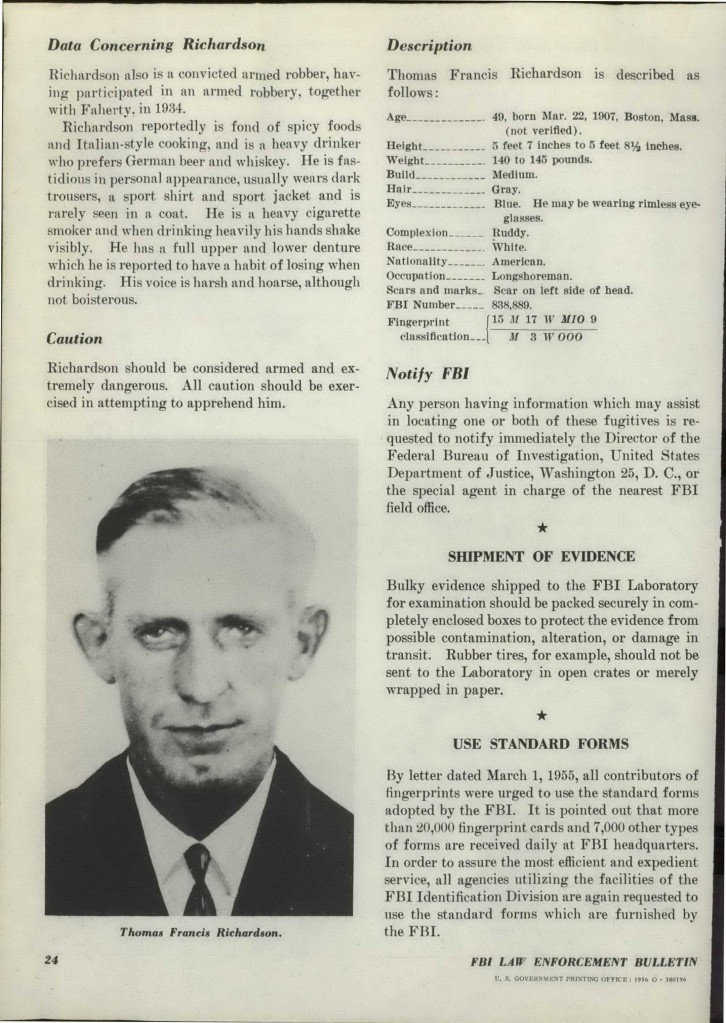
Thomas Francis Richardson Richardson was arrested with Faherty in May 1956 and later convicted in the Brink’s robbery.
Archival FBI wanted notice · FBI Law Enforcement Bulletin · May 1956, p. 24 · U.S. public domain- Anthony Pino
Convicted in the Brink’s robbery
Photo at source · FBI · archival mugshot
Look closer · 3 visuals
Inside the evidence.
Open a visual to explore what it contributed to the case—and the limits of what it shows. Photographs, historical reproductions and original illustrations are individually labeled. Open the notes for each image’s source, credit, and limitations; setting photographs do not depict crime scenes.
The cap that did not name a robber
FBI photograph of the actual cap recovered at the scene.
Read the evidence notes
The cap was one of the few physical clues left behind. Its examination did not establish who wore it.
The FBI photographed the preserved artifact for its collection.
Source 1 ↗ · Source 2 ↗ · Federal Bureau of Investigation · Image source · Public Domain Mark

Genuine money, identifiable theft
Original editorial illustration — not an actual evidence photograph or exhibit.
Read the evidence notes
Recorded identifiers linked money found in Baltimore to the robbery.
No actual currency or serial numbers reproduced.
An insider breaks the silence
Original editorial illustration — not an actual evidence photograph or exhibit.
Read the evidence notes
O’Keefe’s cooperation supplied an account investigators could compare with other evidence.
Not an authentic statement or a claim that every assertion stood without corroboration.
★ Key evidence used in a conviction · ✓ Exclusion or reversal · ◇ Disputed evidence · ⊘ Excluded at retrial · ◆ Identity / investigative finding, not a conviction. A symbol does not mean one item proved the whole case.
Follow the locations
Put the story on the map.
Follow the dated entries, then select an event to find its regional setting. Shared-location pins open a group of events. Evidence symbols identify important findings and their limitations.
Open the map in its own window ↗Sources & further reading
- FBI history: Brink's RobberyRobbery, investigative leads, grand jury, O'Keefe cooperation, recovery and convictions.
- FBI artifact record: Brink's Robbery CapSurviving physical artifact associated with the robbery.
Editorial review: 2026-11-12 · 597 words