Frank Almond was carrying his violin to the car after a concert at Wisconsin Lutheran College on January 27, 2014. Someone used a stun gun on him and took the case. Milwaukee police found the case beside a road within hours. The violin and two bows were gone. [1]
The violin was made by Antonio Stradivari in 1715 and named for the Polish violinist Karol Lipinski. Almond, the Milwaukee Symphony Orchestra’s concertmaster, had been playing it on loan since 2008. An instrument with that history was recognizable enough to make selling it difficult. It was also a working instrument whose condition mattered every day it was missing. [1]
A weapon to trace
Investigators used evidence from the stun gun to trace its purchase to Universal Knowledge Allah, a Milwaukee barber. A tip that came in while a $100,000 reward was available led investigators to Salah I. Salahadyn. The police arrested both men about a week after the robbery. The arrests gave them people they could question. They still didn’t have the violin. [1] [2]
FBI agent David Bass was concerned about how it was being stored. Cold or humidity could do lasting damage. Nine days after the attack, Salahadyn took investigators to a Milwaukee house. Bass borrowed a ladder from the team at the scene and climbed into an attic crawl space. The violin and the bows were inside an old suitcase, wrapped in a baby blanket. The FBI reported that the instrument was in good condition. [1]
What the return was worth in court
Salahadyn agreed to return the violin and plead guilty to robbery as a party to the crime in exchange for limits on further charges. On appeal, he argued that prosecutors had broken the agreement by saying they could bring a more serious charge if he declined to plead and went to trial. The Wisconsin Court of Appeals read the agreement as requiring both things: the return of the instrument and a guilty plea. It reviewed his answers to the trial judge about the plea and affirmed the judgment in March 2016. [2]
The judge weighed Salahadyn’s assistance in recovering the instrument alongside the assault on Almond and his involvement of other people. Salahadyn received seven years in prison and five years of extended supervision. Allah, who had provided the stun gun and pleaded guilty, received three and a half years in prison followed by three and a half years of extended supervision. [1] [2] [3]
Later in 2014, Almond went to the FBI’s Milwaukee office. Some of the people who’d helped find the instrument were there. He played it for them. [1]
Case brief
Milwaukee, Wisconsin · 2014
- Recorded outcome
- Both defendants pleaded guilty in 2014; Salahadyn's conviction and sentence were affirmed in March 2016.
Key moments
People and case photographs
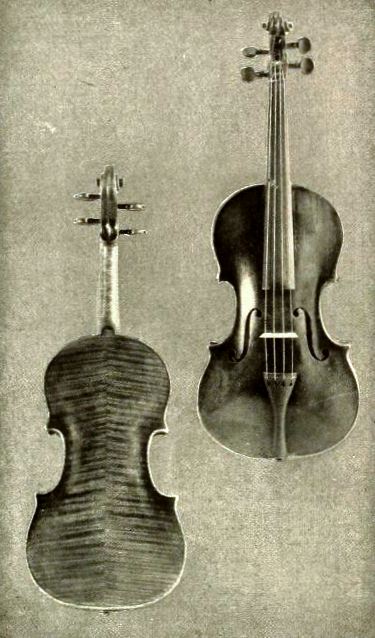
The Lipinski Stradivarius Front and back views of the violin stolen from Frank Almond in 2014, published in Shadowland in January 1923.
Archival photograph · Unknown photographer · Shadowland, January 1923, p. 58 · U.S. public domain- Frank Almond
Violinist from whom the Lipinski Stradivarius was stolen
Photo at source · Milwaukee Magazine · profile photographs
Look closer · 3 visuals
Inside the evidence.
Open a visual to explore what it contributed to the case—and the limits of what it shows. Photographs, historical reproductions and original illustrations are individually labeled. Open the notes for each image’s source, credit, and limitations; setting photographs do not depict crime scenes.
A violin with a musical life
Archival photograph of the exact violin, published in 1923.
Read the evidence notes
The image shows both sides of the Lipinski. Frank Almond had played the instrument since 2008 when it was stolen in 2014.
The photograph predates the robbery by more than 90 years.
Source 1 ↗ · Unknown photographer · Shadowland, January 1923, p. 58 · Image source · U.S. public domain


A purchase trace supplies a name
Original editorial illustration — not an actual evidence photograph or exhibit.
Read the evidence notes
Investigators traced the weapon’s purchase to Allah while a separate tip concerned Salahadyn.
Generic transaction symbol; no weapon instructions or original sales record shown.
The suitcase in the attic
Original editorial illustration — not an actual evidence photograph or exhibit.
Read the evidence notes
Salahadyn led investigators to the violin and two bows nine days after the robbery.
Generic suitcase, not the actual container or a view of a private home.
★ Key evidence used in a conviction · ✓ Exclusion or reversal · ◇ Disputed evidence · ⊘ Excluded at retrial · ◆ Identity / investigative finding, not a conviction. A symbol does not mean one item proved the whole case.
Follow the locations
Put the story on the map.
Follow the dated entries, then select an event to find its regional setting. Shared-location pins open a group of events. Evidence symbols identify important findings and their limitations.
Open the map in its own window ↗Sources & further reading
- FBI history: Stradivarius Violin CasesAttack, weapon trace, reward tip, nine-day recovery, FBI's motive theory and historical outcomes.
- State v. Salah I. Salahadyn, 2015AP1962-CRNMCourt spelling; plea, negotiated recovery, sentence components, defense challenges and affirmance.
- Mastermind of Lipinski Stradivarius theft receives seven-year prison sentenceJanuary 27 attack date, Allah's three-and-a-half-year confinement and supervision, and dated sentencing coverage.
Editorial review: 2026-11-12 · 437 words